Certified Environmental Management
As part of its HSE management, Linde MH strives to minimize the impacts it has on the environment. In particular, the company aims to use resources responsibly and consistently reduce its local environmental impact. To do this, Linde MH pursues an indicator-based approach, focusing on energy and greenhouse gas (GHG) emissions, water, and waste.
The company’s integrated management guideline “Quality – Health and Safety at Work – Environment – Energy” requires the management and all executives to ensure processes and production operations are environmentally friendly and energy efficient. Waste is also to be avoided wherever possible, and natural resources such as water, soil, and raw materials used in a sparing and responsible way. In addition, the guideline requires and promotes efforts to avoid or decrease the release of emissions into the air, water, and soil as well as active steps aimed at reducing GHG emissions generated by business activities.
Some Linde MH sites are developing specific strategies to take local conditions into account, in addition to the Group-wide HSE standard of KION. To support these efforts, an HSE officer has been appointed for each national subsidiary.
A key target in the Group-wide sustainability strategy is for all sites to obtain the ISO 14001 (environmental management) certification. Regular audits provide transparency regarding sustainability performance as well as the basis for continuous improvement in this area.
Percentage of Sites Certified under ISO 14001

Energy
The Group aims for a complete switch to green electricity by 2030. In fiscal 2025, Linde MH sourced 99 percent of its purchased electricity from renewable sources, both in its plants and in its branches. In addition to the environmental benefits, switching to green electricity has also generated significant cost savings. The sites in Germany and the Czech Republic are leading the way in this respect and demonstrating that the use of renewable energies can make both environmental and economic sense.
The German production sites and other Linde MH sites in Germany and other countries are certified in accordance with ISO 50001 (energy management) and are regularly reviewed as part of the current certification cycle.
Certification supports continual improvements in the area of energy efficiency, and the warehouse technology plant in Châtellerault is a prime example of this. This plant’s building technology makes it possible to determine lighting and heating operating times based on the outside temperature or sunlight, which generates significant energy savings. The team in Châtellerault initiated the ISO 50001 certification process back in 2013, and it was completed in 2015. This makes the plant a pioneer within KION.
New sales and service locations must comply with standards for construction and building technology to reduce energy consumption. These include – for example, at Willenbrock Fördertechnik in Burgwedel – energy-efficient façades and alternative heating systems (such as air source heat pumps), LED lighting with daylight control, green roofs, insect-friendly systems, and preparations for the installation of photovoltaic systems.
There are numerous other examples of energy savings achieved through process optimization in the company:
Thanks to a precise process analysis, significant energy savings have been achieved on the powder painting line at the largest plant of Linde MH in Aschaffenburg. Some 20 fans and four cooling towers were being used to provide the mast cooling for the line. The process analysis showed that there was no need for so many resources and that the energy consumption was therefore too high. By optimizing the cooling zones, one cooling tower and four fans could be switched off, resulting in energy savings of approximately 25 percent for this process.
Own renewable energy production at Linde MH Ibérica, Spain: The installation of 252 solar panels on the roof in conjunction with two inverters with remote control and monitoring has generated savings of 380,000 euros and around 10.5 metric tons of CO2eq annually.
By switching from a mix of energy sources to 100% renewable energy, Jetschke Industrie in Germany has achieved annual savings of 1,100 euros and 19 metric tons of CO2eq.
Reducing compressed air leaks cuts energy consumption: Leaks lead to higher energy consumption and higher costs, which should be avoided for economic and environmental reasons. A single one-millimeter leak costs around 500 euros per year due to wasted energy. That is why the team at Linde MH Aschaffenburg meticulously searches for and eliminates leaks in the compressed air network, for example by replacing maintenance units, tools, shut-off valves, vents, and porous compressed air hoses.
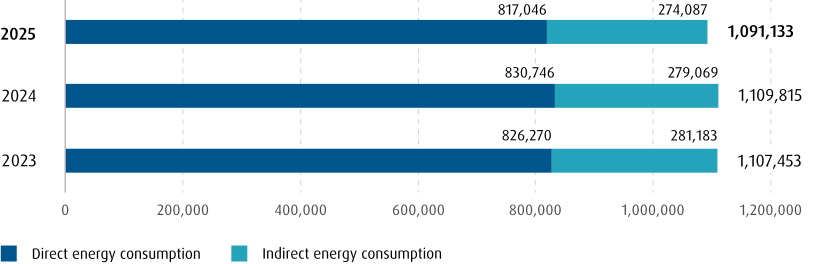
Direct and Indirect Energy Consumption in GJ
|
|
2025 |
|
2024 |
|
2023 |
|---|---|---|---|---|---|---|
Total energy consumption, direct and indirect |
|
1,091,133 |
|
1,109,815 |
|
1,107,453 |
Direct energy consumption |
|
817,046 |
|
830,746 |
|
826,270 |
Diesel (non-renewable) |
|
336,304 |
|
357,552 |
|
358,726 |
Gasoline (non-renewable) |
|
51,710 |
|
33,870 |
|
28,874 |
Ethanol (non-renewable) |
|
34 |
|
34 |
|
34 |
Heating oil (non-renewable) |
|
18,262 |
|
17,307 |
|
2,299 |
Hard coal (non-renewable) |
|
93 |
|
91 |
|
92 |
Coke (non-renewable) |
|
130,917 |
|
153,045 |
|
162,344 |
Natural gas (non-renewable) |
|
259,537 |
|
249,698 |
|
249,476 |
Compressed natural gas (non-renewable) |
|
1,308 |
|
2,223 |
|
5,811 |
LNG (non-renewable) |
|
195 |
|
37 |
|
36 |
LPG (non-renewable) |
|
9,019 |
|
10,741 |
|
13,850 |
Other direct energy consumption (non-renewable) |
|
0 |
|
0 |
|
20 |
Biodiesel (renewable) |
|
1,281 |
|
0 |
|
0 |
Bioethanol (renewable) |
|
543 |
|
560 |
|
400 |
Wood chips (renewable) |
|
5,053 |
|
4,006 |
|
– |
Hydrogen (renewable) |
|
7 |
|
8 |
|
3 |
Self-generated solar power (renewable) |
|
2,783 |
|
1,575 |
|
1,042 |
Indirect energy consumption |
|
274,087 |
|
279,069 |
|
281,183 |
Electricity |
|
262,070 |
|
267,572 |
|
272,388 |
Heat |
|
12,017 |
|
11,497 |
|
8,795 |
Water
Linde MH and its production facilities are based in regions with sufficient water supplies and good local infrastructure. The company makes sure that all facilities on its premises comply with the applicable safety and environmental regulations and are regularly checked to ensure that they are in good working order.
Measures have been taken at the plants to reduce water withdrawal, such as the instruction to wash company vehicles only when necessary. Existing plants and equipment are updated whenever buildings are renovated or facilities are upgraded or installed:
The powder painting line at the Aschaffenburg plant has been at the cutting edge of technology since 2019. The process is fully automated and can completely eliminate pollution, volatile organic compound emissions (VOCs), and the need for water treatment thanks to the technologies in place. Solvent emissions alone have fallen by almost 25 metric tons per year.
At the Weilbach production site, a special sweeper has been commissioned to clean outdoor areas on a daily basis. The machine is equipped with effective filters that have resulted in significant reductions in dust emissions during the sweeping process. Moreover, the low-noise machine needs only 40 percent of the water volume used by the previous equipment and is more energy efficient.
At the same site, closed cooling circuits are used for sand conditioning and in the cupola furnace to reduce water withdrawal. In these systems, the main aim of coolant treatment is to prevent corrosion by means of softening or desalination and chemical dosing. This means that water is rejected only when the salt content reaches a certain level.
Willenbrock Fördertechnik conserves water by using a cistern to collect rainwater. With a capacity of 20,000 liters, it can collect a large amount of water when it rains, which is then used to flush toilets in the building and irrigate green outside spaces.
At the Barcelona site, a washing plant with water treatment has been installed to reuse water and keep water withdrawal to a minimum.
Business activities of Linde MH have only a very minor impact on water quality, so apart from the use of light liquid separators, there is no need for any further pretreatment of wastewater prior to disposal. Nevertheless, Linde MH has its wastewater regularly monitored by external analyses, which are in turn monitored through internal reporting processes that record volumes and treatment methods. Water withdrawals and wastewater are regularly monitored by means of monthly sampling and analyses, for example.
Climate Protection
As part of international efforts to limit global warming and address the many challenges associated with climate change, Linde MH and its partners must also take proactive and forward-thinking action to protect the world’s climate. Linde MH works closely with its customers, suppliers, and business partners in many different areas – including energy consumption, efficient use of resources, and mitigation of GHG emissions – to ensure that it is making a difference within its own operations and beyond.
The climate and energy management policy of KION is based on the 2015 Paris Agreement, which aims to limit global warming to 1.5°C above pre-industrial levels on a cross-sector basis. After setting initial climate targets in 2018 and carrying out a comprehensive strategy review starting in 2021, KION made a public commitment in 2023 to achieve net-zero GHG emissions across its entire value chain by 2050 at the latest. In 2024, the Science Based Targets initiative (SBTi) has formally validated the short-term climate targets and net-zero target of KION (see “Key Targets”). All of the Group’s stated GHG targets are gross targets and do not include negative GHG emissions, CO2 offsets, or avoided GHG emissions as a means of achieving the GHG emissions reduction targets.
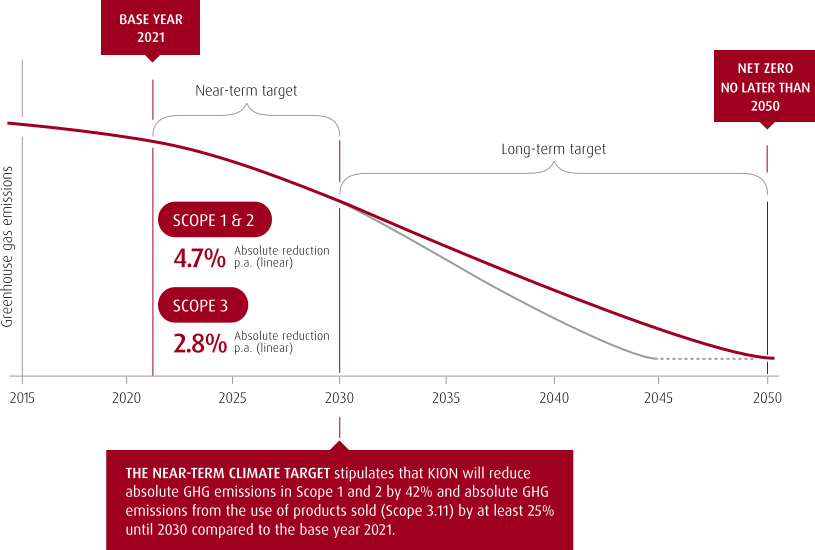
The Group has put in place a comprehensive climate management system to ensure effective and efficient management of GHG emissions and energy use, including the promotion of renewable energies. This system covers the company’s own operations as well as upstream and downstream activities within the value chain, from purchasing and production to use and reuse at the end of the life cycle. The internationally recognized standards of the Greenhouse Gas Protocol (GHG Protocol) serve as the methodological basis for recording and controlling GHG emissions.
KION intends to make future investments in order to achieve the strategic targets related to climate protection and adaptation to climate change. The timing and scope of such investments are currently in the planning phase. Further details are to be provided in a transition plan for fiscal 2026.
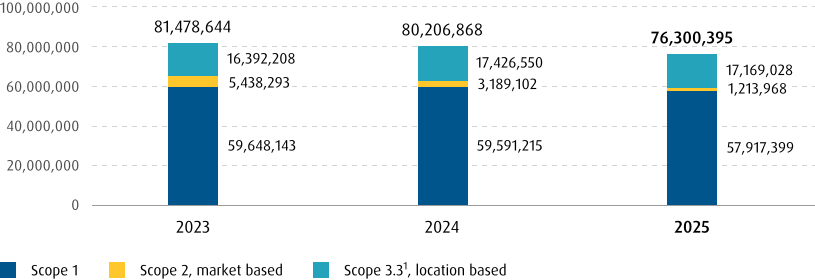
GHG Emissions in kg CO2eq
|
|
2025 |
|
2024 |
|
2023 |
||||
|---|---|---|---|---|---|---|---|---|---|---|
Scope 1 |
|
57,917,399 |
|
59,591,215 |
|
59,648,143 |
||||
Scope 2, market based |
|
1,213,968 |
|
3,189,102 |
|
5,438,293 |
||||
Scope 3.31, location based |
|
17,169,028 |
|
17,426,550 |
|
16,392,208 |
||||
Total emissions |
|
76,300,395 |
|
80,206,868 |
|
81,478,644 |
||||
|
||||||||||
Climate Protection Measures for CO2 Reduction
To reduce emissions from its own operations, Linde MH is pursuing various measures – from electrifying the vehicle fleet and offering more sustainable mobility options for employees to the comprehensive transformation of the Aschaffenburg‑Nilkheim plant with the aim of increasing energy efficiency and driving decarbonization.
To reduce GHG emissions from its own operations (Scope 1), Linde MH is gradually replacing combustion engine vehicles in its service and company vehicle fleet with electric vehicles. In fiscal 2025, this concept for cleaner, quieter, and more sustainable mobility was systematically advanced throughout the EMEA region. The goal is electrification across the entire vehicle fleet – from company cars to service vans. To this end, a practical and future-proof e-mobility concept was first developed for Germany, which is to be implemented nationwide in 2026 and serves as a blueprint for the entire EMEA region. The basis was a detailed analysis of charging options at home, at work, on the road, and at the customer’s premises, as well as the necessary infrastructure. To ensure the operational capability of electric vans, particularly in the service business, technical and regional requirements regarding range, payload, and charging times of the relevant vehicle types were carefully examined. This decarbonization approach in Scope 1 is closely linked to the reduction of GHG emissions in Scope 2, as fleet electrification goes hand in hand with increased use of renewable energy in the company’s own operations (see “Energy”). Linde MH Nordic Markets (Denmark, Sweden, Norway) already has a company car policy that permits only hybrid and electric vehicles.
To further promote sustainable mobility, all German KION companies offer their employees the opportunity to use a portion of their gross pay to lease a bicycle, which they can then use outside of their commute as well.
For the plant in Aschaffenburg-Nilkheim, a comprehensive energy transformation concept is continuing in its implementation; its development began in 2023 and it was presented in 2024. The concept pursues three central objectives: First, it aims to create transparency regarding energy consumption and emission sources at the plant. Second, it identifies potential savings and substitution options in order to gradually reduce the use of fossil fuels such as natural gas, heating oil, diesel, and gasoline. Third, the concept forms the strategic basis for reducing GHG emissions (Scopes 1 and 2) by at least 40 percent compared with the base year 2021 over a period of ten years.
In the area of heating, heating circuit pumps were gradually replaced with electronically controlled pumps as early as 2024 in order to continuously increase energy efficiency. In addition, a new boiler was installed that enables the use of alternative fuels such as hydrogen and biodiesel (FAME), creating an important prerequisite for decarbonization. The use of waste heat potential from the cooling tower and diesel cooling systems, and their integration into the central heating network, is part of a broader heating concept. For this purpose, the first cooling tower was completely refurbished and adapted to current needs in 2025. In addition, various refurbishment and optimization measures that had already been initiated in 2023 and 2024 were continued.
As planned for the entire EMEA region, another focus of the transformation concept is the electrification of the vehicle fleet in Aschaffenburg. During the reporting year, work began on expanding the charging infrastructure for the electrification of shuttle trucks and company vehicles, with completion planned for 2026. While the electric trucks are used in shuttle service between the foundry and the assembly plant to transport counterbalances, the electric transporters handle logistics between the regional locations with zero emissions. With the new electric fleet, Linde MH aims to save around 180 metric tons of CO2eq per year at this site.
Overall, the measures implemented in the reporting year resulted in savings of over 843 MWh of electricity and gas, as well as around 157 metric tons of CO2eq. Additional savings measures will be implemented gradually over the coming years.
Offsetting via Certified Climate Protection Projects
In addition to reducing emissions, Linde Material Handling in Switzerland also focuses on offsetting transport emissions: Since 2022, emissions generated during domestic deliveries of products have been offset through certified climate protection projects. The company works with Swiss Climate to purchase emission certificates and support selected projects.
The supported project generates renewable energy from sawdust produced during the production of raw material for paper manufacture. The sawdust is used as biomass for generating steam, which in turn serves as an energy source for the production of more raw materials. This regenerative system therefore enables fossil energy sources to be replaced as a heat source. The biomass project is one of the few climate protection projects in Europe to have been awarded the “Gold Standard” by Swiss Climate.
From 2026 onward, the Swiss company plans to use electric trucks for deliveries to customers, thereby replacing the previous compensation via climate credits with a direct reduction of emissions in its own operations.
Additional Emissions Monitoring
Linde MH buildings are usually located in industrial areas where no residents live. Ongoing checks and measurements have shown that noise barriers are not needed. However, the company does employ internal noise protection measures, such as enclosures for the relevant work areas, roller shutters in workshops, and personal protective equipment.
Linde MH has systems for filtering exhaust air – such as exhaust gases, paint, and welding fumes – at many sites as well as dedusting systems in trucks. Highly effective filter systems are installed in the foundries in particular to minimize the release of fine dust into the atmosphere and environment. Where emissions are generated by painting and heating systems, Linde MH uses highly effective combustion processes that minimize pollutants in the gases emitted into the atmosphere and feed the heat generated back into the buildings or manufacturing processes.
Other Significant Air Pollutant Emissions in kg

|
|
2025 |
|
2024 |
|
2023 |
||||
|---|---|---|---|---|---|---|---|---|---|---|
Total quantity of other significant airborne emissions |
|
92,041 |
|
95,475 |
|
134,012 |
||||
Carbon monoxide (airborne emissions, CO) |
|
14,621 |
|
19,571 |
|
18,347 |
||||
Nitrogen oxides (NOx) |
|
19,697 |
|
20,286 |
|
18,318 |
||||
Sulfur oxides (SOx) |
|
5,0281 |
|
5,0951 |
|
34,009 |
||||
Volatile organic compounds (VOCs) |
|
42,795 |
|
40,749 |
|
41,425 |
||||
Particulate matter (PM) |
|
3,723 |
|
3,505 |
|
3,492 |
||||
Other airborne emissions |
|
6,178 |
|
6,269 |
|
18,421 |
||||
|
||||||||||
Efficient Use of Resources
Linde MH has introduced resource-saving measures at nearly all of its sales and service entities – including opportunities for truck refurbishment, return systems for batteries, and partnerships for the return and recycling of tires. The refurbishment process extends the service life of forklift trucks and improves material efficiency and the environmental balance, such as their carbon footprint, energy consumption, and VOC emissions. This significantly reduces the overall demand for energy and raw materials, as well as the amount of waste generated.
The mixed production line in Aschaffenburg, where several different truck models are assembled on the same line, is another example of how the company is using resources more efficiently. As well as offering economic advantages, this production method is also extremely beneficial from an environmental perspective: The smaller production area reduces the need for raw materials and energy for the construction, operation, and maintenance of the infrastructure. The level of automation in production was also increased in the case of forklift trucks built on the mixed production line, for example through robotic welding. This not only has environmental benefits, such as reducing spikes in electricity usage, but also health benefits, as employees in many areas are no longer directly exposed to the hazards of the welding process, such as heat and smoke.
Making the most economical use of resources has become the established approach at the Weilbach site, too: Parts that are indispensable for all forklift trucks have been cast here since 1975. The team at the foundry produces counterbalances that are made entirely from melted scrap from all over Europe and are assembled in Aschaffenburg. Depending on the product line, a counterbalance can weigh between 700 and 3,300 kilograms.
Replacing critical or hazardous substances with less critical ones is also an important aspect of responsible resource management. This applies both to raw materials and to operating materials that are required for production but do not form part of the end product. For example, the hazardous substance methylene chloride, which was commonly used to clean paint spray guns, has been replaced with a less dangerous substance in recent years. A less hazardous product is now also used to rinse painting facilities.
The careful use of resources also requires the careful disposal of waste. Linde Pohony in the Czech Republic, for example, uses waste compactors that are suitable for plastic and paper waste. They reduce fuel consumption and CO2 emissions because the volume of waste transported is lower. They are also covered to prevent contamination of rainwater. In France, Fenwick-Linde stopped sending industrial waste to landfill in February 2023 and is working with the waste-to-energy plant in Limoges to recycle all of its waste. The material is recycled in a combustion plant, and the heat generated is converted into electricity via a turbine and fed into the grid.
The headquarters in Aschaffenburg and production plant in Nilkheim are also reducing their waste in another specific area. With RECUP and REBOWL, a system with more than 13,900 takeout and return points, the company avoids 30 kilograms of waste a day while saving 30,000 euros every year.
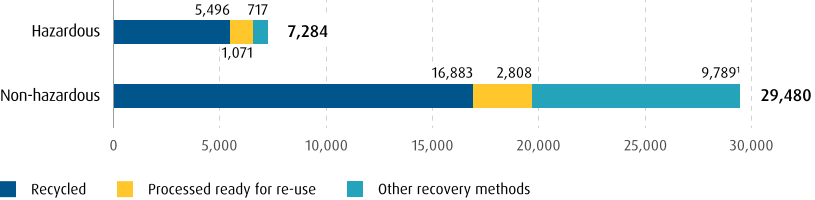
Hazardous and Non-hazardous Waste for Recycling/Re-use in t in 2025
|
|
2025 |
|
2024 |
|
2023 |
||||
|---|---|---|---|---|---|---|---|---|---|---|
Hazardous waste for recycling/re-use |
|
7,284 |
|
6,603 |
|
5,534 |
||||
Recycled |
|
5,496 |
|
4,872 |
|
4,550 |
||||
Processed ready for re-use |
|
1,071 |
|
922 |
|
646 |
||||
Other recovery methods |
|
717 |
|
809 |
|
338 |
||||
Non-hazardous waste for recycling/re-use |
|
29,480 |
|
30,700 |
|
28,177 |
||||
Recycled |
|
16,883 |
|
16,641 |
|
24,326 |
||||
Processed ready for re-use |
|
2,808 |
|
2,940 |
|
3,532 |
||||
Other recovery methods |
|
9,7891 |
|
11,1191 |
|
319 |
||||
|
||||||||||
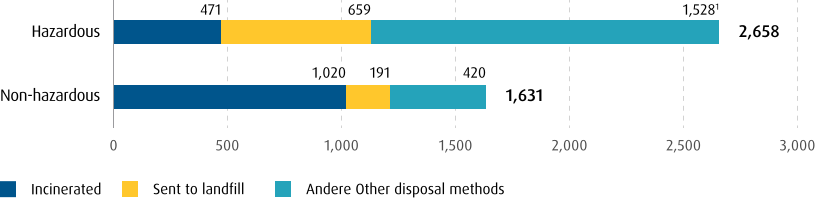
Hazardous and Non-hazardous Waste for Disposal in t in 2025
|
|
2025 |
|
2024 |
|
2023 |
||||
|---|---|---|---|---|---|---|---|---|---|---|
Hazardous waste for disposal |
|
2,658 |
|
2,503 |
|
1,668 |
||||
Incinerated |
|
471 |
|
423 |
|
675 |
||||
Sent to landfill |
|
659 |
|
599 |
|
511 |
||||
Other disposal methods |
|
1,5281 |
|
1,4821 |
|
482 |
||||
Non-hazardous waste for disposal |
|
1,631 |
|
2,379 |
|
3,150 |
||||
Incinerated |
|
1,020 |
|
1,492 |
|
1,817 |
||||
Sent to landfill |
|
191 |
|
428 |
|
802 |
||||
Other disposal methods |
|
420 |
|
459 |
|
530 |
||||
|
||||||||||
|
|
2025 |
|
2024 |
|
2023 |
|---|---|---|---|---|---|---|
Hazardous waste |
|
9,942 |
|
9,106 |
|
7,202 |
Non-hazardous waste |
|
31,111 |
|
33,079 |
|
31,327 |
Total waste for disposal |
|
4,288 |
|
4,882 |
|
4,817 |
Total waste for recovery |
|
36,764 |
|
37,303 |
|
33,711 |
Environmental Protection in Day-to-Day Work
The mandatory HSE (Health, Safety, and Environment) training completed by staff each year covers a range of environmental, climate, and energy management topics that are relevant for the business, including energy consumption, water usage, waste separation, and the risks posed by climate change.
Percentage of Sites Where Employees Received Training on Environmental Topics as Part of HSE Training

The numerous environmental protection campaigns organized over the years are a testament to the company’s success at raising employee awareness of environmental issues:
Every year at Easter, the “Recycling Bunny” visits employees in Switzerland with ideas, tips, and suggestions relating to sustainability and health.
A green roof has been installed at Willenbrock Fördertechnik specifically to protect bees and insects: The 1,087 m2 roof of an office building has been planted with grass, shrubs, and flowers to provide a source of food for bees and other insects. Green roofs like this not only promote local biodiversity but also improve air quality, lower the ambient temperature, and store rainwater. Going forward, the plan is to install an economically viable number of PV systems covering a total area of 9,304 m2 on the hall roof in order to produce renewable energy and reduce the company’s dependence on fossil fuels.
Information on potential ways to reduce energy consumption has been posted in the buildings at Fenwick-Linde’s branches in France and this was already generating savings of around 5,100 euros and a reduction of 10 metric tons of CO2eq in 2022.
Idea Management
Idea Management has been an established part of Linde MH for many years now and supports the continuous development of the company through the suggestions provided by employees. Quality standards, productivity, and employee satisfaction are thus improved across the company based on the insights and experiences of the staff as a whole. The aim is to leverage untapped potential for improvement and incorporate these areas into the ongoing improvement process for the entire product and service portfolio, which comprises both production and work processes as well as working conditions, including health and safety and environmental protection. Ideas for improvement are assessed by an expert in the relevant field against a defined set of criteria and given a score, with prizes awarded for the best-scoring ideas.
One new idea from an employee will directly strengthen the materials cycle in the future: Used blasting media (steel scrap) from production, which was previously recycled externally, is to be returned directly to the supplier with new deliveries and immediately processed for reuse. This reduces transport and disposal costs, lowers CO2 emissions and the need for primary steel, and at the same time increases resource efficiency along the supply chain. Following a successful test phase in 2025, full implementation is planned for fiscal 2026.
As part of an idea management campaign focused on ecological sustainability, a sensor-based analysis for controlling the compressed air network was introduced in 2023. The optimization potential identified in this way also enabled savings of 300 MWh at the Aschaffenburg-Nilkheim production site in fiscal 2025. Building on this, an AI-supported compressed-air leak detection system was implemented in 2025, enabling demand-based rather than cyclical leak detection and thereby further increasing efficiency.
In addition, the parts production and spare parts distribution center in Kahl am Main, as well as the foundry in Weilbach, were identified as suitable locations for expanding this measure. Implementation at both plants is planned for 2026.
Another measure, initiated in 2024 and in the implementation phase in 2025, concerns targeted control of hall lighting in the parts production and spare parts distribution center in Kahl am Main. During regular break times, the lighting is dimmed by up to 50 percent – a solution that saves around 9 kWh of energy per day and also signals the start of the break to employees. Expansion of this measure to the Aschaffenburg-Nilkheim production site is planned for 2026.
With these measures, Linde MH is reducing its environmental footprint and underlining its commitment to the responsible use of resources. The savings achieved are intended to motivate the implementation of similar measures at additional locations.
Fleet and Transport Management
In terms of the switch to more environmentally friendly drives, the fleet and transport management strategy is to replace the company’s own combustion vehicles with electric models. For example, Jetschke Industriefahrzeuge in Germany – a subsidiary of Linde MH – has already replaced two diesel vans with two electric vans and replaced two diesel vehicles with purely electric vehicles plus a further eight diesel vehicles with plug-in gasoline hybrid vehicles.
In addition, the area management plan for service technicians has been restructured at all Fenwick-Linde branches in France in order to optimize the fleet and routes. At Loire Océan Manutation, also in France, route planning has been optimized to achieve a better distribution of customer service technicians’ sectors by forming groups of two according to customers and geographical areas.
The use of the new Area Reform software also enabled Linde Magyarország Anyagmozgatási in Hungary to reduce fuel consumption by optimizing the routes and thus the emissions of service vehicles.
Fourteen new EV charging stations were installed at Willenbrock Fördertechnik – eight in Bremen and six in Großburgwedel – to promote e-mobility among employees. The company’s vehicle fleet currently consists of 26 hybrid vehicles and two electric vehicles.
Beginning in 2026, two electric trucks will take over the transport of forklift counterbalances from the foundry 35 kilometers away to the assembly plant in Aschaffenburg. In addition, ten more electric vans will be used by Central Services and will make an important contribution to decarbonizing journeys within and between sites in the Aschaffenburg region.