

KION has consolidated its procurement – also referred to as “purchasing” – into a centrally managed global organization, which covers the suppliers of Linde MH. Sustainable supply chain management requires an effective governance structure, high levels of process standardization, reliable data quality, and appropriate and workable policies that are intended to apply across all business units and legal entities within Linde MH. This is ensured by a central supplier sustainability department at KION, which bears responsibility across all organizational units.
The supplier sustainability program is embedded in the sustainability strategy of KION and measures the effectiveness of activities using KPIs. The central purchasing organization shapes and manages the flow of information and materials at all stages in the value chain, based on both business and sustainability criteria. In addition to procuring parts and services that make sustainable use of resources, the goal of Linde MH is to ensure that the various parts of the value chain live up to certain defined standards in terms of human dignity, working conditions, and environmental compatibility. To this end, KION has set up an information and analysis system to record relevant data and information to support the effective management of the supply chains for its key procurement items and materials.
Principles of Supplier Conduct
The Group has laid down specific requirements and rules of conduct for responsible procurement in the KION Group Code of Compliance and in the Supplier Code of Conduct and obliges its suppliers to observe these requirements when entering into business agreements with Linde MH companies. The Supplier Code of Conduct contains clear ecological and ethical guidelines in line with environmental, labor, and human rights standards and is available in multiple languages in the most important procurement markets.
In addition, the General Purchasing Conditions of KION and individually agreed contracts set out detailed requirements to ensure compliance with procurement obligations, applicable laws, and the KION Supplier Code of Conduct, as well as for maintaining transparency throughout the supply chain. All these Group-wide regulations are binding for KION as a whole, including all legal entities of Linde MH, and are regularly reviewed to ensure they are up to date and complete.
ESG Supplier Risk Management Process
To objectively and reliably assess the sustainability risks and performance of its key suppliers, KION has introduced an ESG (Environmental, Social, Governance) assessment process that utilizes the SaaS (Software as a Service) platforms of EcoVadis and IntegrityNext. Since 2022, KION has been running industry and country risk analysis on all suppliers – regardless of revenue or product supplied – using the EcoVadis “IQ” platform, in order to determine their risk profile with regard to sustainability.
This multi-stage approach verifies that suppliers comply with specific standards in the areas of HSE, anti-corruption and anti-bribery measures, and monitoring of upstream supply chains. Above all, this process ensures that suppliers are compliant with human rights, employee rights, and employment standards. The KION GROUP AG thus complies with legal requirements, such as the German Supply Chain Due Diligence Act, but also laws such as the UK Modern Slavery Act and the Canadian Modern Slavery Act. The system is designed to be flexible and can be adapted to changing requirements.
Percentage of Direct Procurement Spend of Linde MH Allocated to Tier-1 Suppliers Covered by a Global ESG Risk Assessment (EcoVadis IQ)

Based on this, an individual supplier self-assessment is obtained via the IntegrityNext and EcoVadis platforms. Self-assessment questionnaires are used to determine the maturity level of suppliers with regard to compliance with human and labor rights as well as environmental protection. This assessment is carried out for strategic suppliers (A suppliers) as well as for business partners identified as high-risk suppliers in the first step. When suppliers choose to be rated via EcoVadis, the provider conducts an independent verification of the responses.
Percentage of Direct Procurement Spend of Linde MH Allocated to Tier-1 A Suppliers Covered by an Individual Risk Assessment (EcoVadis or IntegrityNext)

As a result, an individual risk is determined for each supplier, based on which the suppliers are classified into one of the following three categories: “low ESG risks,” “possible ESG risks to a certain extent,” or “high ESG risks.” Suppliers with an existing risk are prioritized according to the severity and likelihood of a possible risk occurring. Based on this prioritization, suppliers are contacted to implement individual corrective measures. These measures are defined based on the existing risk and the suppliers’ level of knowledge and may include supplier audits, corrective action plans, supplier training, individual discussions, various certifications, and other measures. Ideally, corrective measures reduce the risk of rights infringement.
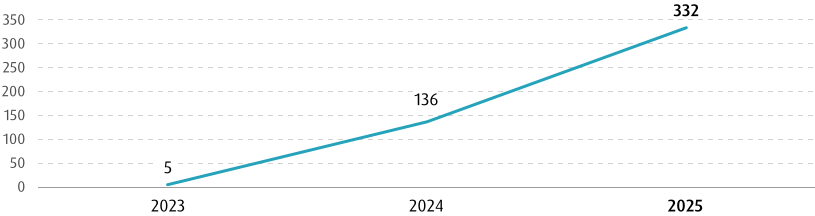
Number of Linde MH Suppliers Who Received a Corrective Measure1
Should a supplier refuse to cooperate in the ESG risk management process, fail to provide information, or obstruct initiatives, an escalation process will be initiated in accordance with the guidelines of KION. Linde MH pursues the approach of working as cooperatively as possible with suppliers, eliminating knowledge gaps and offering support. Ultimately, Linde MH reserves the right to terminate a business relationship if a supplier permanently refuses to cooperate in the ESG risk management process.
The results of the supplier assessment feed into various purchasing processes – including award decisions above certain volumes, material group strategies, and supplier development. Within the strategic “Supply chain” field of action, they are also taken into account in the Group-wide sustainability goals, which can be found under “Key Targets”.
New suppliers are asked about their sustainability credentials as part of the supplier onboarding process and undergo the ESG assessment program. Existing suppliers are reviewed on an ongoing basis. These approaches give Linde MH a transparent way of tracking the sustainability performance of its suppliers and managing risks and opportunities related to the sustainability of the supply chains in a targeted way.
Environmental Product Requirements
Since 2022, data on suppliers’ compliance with environmental product requirements has been systematically collected using the software provider Assent. The current focus is on the ITS EMEA operating unit, which also includes Linde MH. The program collects compliance data on substances of very high concern (SVHCs) according to Article 33 of the European REACH Regulation, on the restriction of hazardous substances according to the EU RoHS Directive, on chemicals according to the Toxic Substances Control Act (US-TSCA), on Article 9 of the European Waste Framework Directive (WFD), on critical raw materials according to EU Regulation 2024/1252, as well as on persistent organic pollutants (POPs) and per- and polyfluoroalkyl substances (PFAS). The effectiveness of the program is monitored using the supplier response rate and the supplier feedback report provided by Assent, which serves as a basis for follow-up measures for the purchasing organization. Reporting is carried out via the Group Sustainability Report in the annual report.
Emissions Transparency in the Supply Chain
With the commitment of KION to achieve the net-zero target according to the SBTi standard by 2050, the continuous reduction of CO2 emissions within the supply chains has also become a binding target. CO2 reduction requirements have since been incorporated into the tactical design of the supply chain. In order to achieve its own climate targets in the upstream value chain (Scope 3.1), selected business partners are motivated and enabled to collect emissions data and to develop reduction plans. With external support, a project was set up with the aim of establishing a holistic approach to measuring and reducing CO2 emissions in the supply chain and integrating these topics into purchasing processes.
The calculation for Scope 3.1 emissions is currently still based on average sales and emissions values. In 2025, the concepts developed in the project were further tested and refined. Strategic suppliers were contacted using standardized questionnaires to assess their knowledge of CO2 calculation, decarbonization plans, and reduction targets. If primary data from suppliers or product-related calculations were already available, these were used as an opportunity to discuss results, decarbonization plans, and existing obstacles individually. Where necessary, targeted support services were offered to suppliers – including online training and technical discussions. By gradually empowering its suppliers, Linde MH aims in the long term to base its calculations predominantly on primary data.
Training of Employees and Suppliers
KION has devised a range of training courses to educate its own employees on human rights and environmental protection in the supply chain. The aim here is to raise awareness among employees of the contribution they can make to compliance with human rights, labor rights, employment standards, and environmental protection in the supply chain. Other training courses cover environmental product requirements and general background information on the sustainability program of KION.
Several topic-specific training courses were also developed specifically for suppliers. These explain why sustainability is becoming increasingly important, the requirements that KION currently places on suppliers, and the underlying reasons for these. The training courses are available on the KION website and were created in English with Chinese subtitles. They are also sent to suppliers via the sourcing portal as needed.
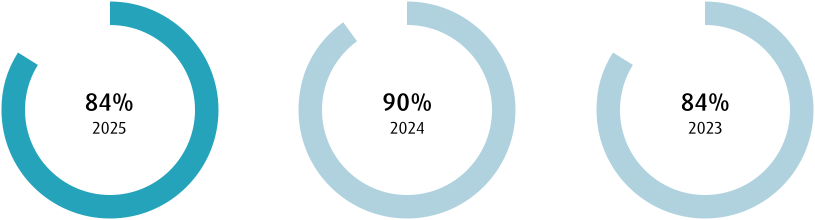
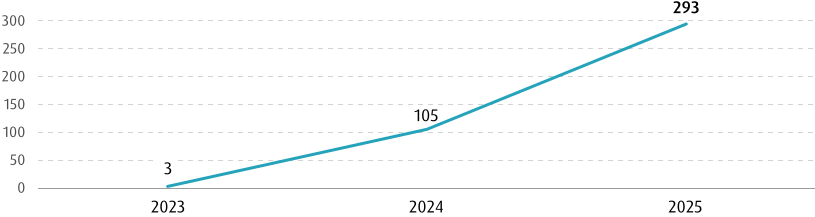
Percentage of Linde MH Buyers Who Have Completed at Least One Training Course on Sustainability in the Supply Chain1
Number of Linde MH Suppliers Who Have Completed at Least One Training Course on Sustainability in the Supply Chain
Conflict Minerals and Critical Minerals
In the 2025 reporting year, the conflict minerals standard of KION was replaced by the Responsible Minerals Sourcing Standard. Both are based on the Due Diligence Guidance for Responsible Business Conduct of the Organisation for Economic Co-operation and Development (OECD), as well as on other relevant guidelines and regulations. The responsible minerals sourcing standard represents a further development in that it includes not only the conflict minerals tin, tantalum, tungsten, and gold, but also other critical minerals such as cobalt, mica, copper, natural graphite, nickel, and lithium. In doing so, it pursues a holistic approach to the responsible procurement of critical minerals and at the same time creates a clear governance structure for this area.
For the first time, KION also published a Due Diligence Report for the reporting year; this can also be viewed on the website and explains the approach and the results in detail. It describes how KION, with the help of the platform provider Assent, uses templates – the Extended Minerals Reporting Template (EMRT) and the Conflict Minerals Reporting Template (CMRT) of the Responsible Minerals Initiative (RMI) – to ask Linde MH suppliers about their upstream suppliers, countries of origin of the minerals, mines, smelters, and refineries. In 2025, information on conflict minerals (such as CMRT) was available for 57 percent of Linde MH suppliers. The information provided by suppliers is assessed for potential human rights violations and any possible contribution to armed conflicts, and checked for corresponding risks.
KION also participates in an annual industry initiative coordinated by Assent, within which smelters and refineries are specifically encouraged to undergo assessments through industry-recognized auditing programs.