
A good workplace must be safe. A Group‑wide KION HSE Standard (Health, Safety, Environment) has been in place since 2018, providing the basis for uniform requirements and processes across the Group. In addition, specific HSE regulations apply to legally independent companies and to sales and service entities. The regulations take into account work-specific and regional circumstances and are continuously adapted to new conditions.
At Linde MH, these Group‑wide standards form the basis for the guidelines governing operational HSE implementation. The company’s detailed regulations meet and often go beyond the basic health and safety standards required by law to ensure that employees have the safest-possible working environment, while at the same time minimizing environmental impact.
Health and Safety form part of the corporate strategy. This also applies to external companies that work for Linde MH. It is important to ensure that their activities are managed in such a way to provide safe conditions for external and in-house employees as well as visitors to Linde MH, and to ensure that applicable safety regulations are observed.
Health Protection
Employee health is always a top priority at Linde MH, so a wide range of measures are taken to promote awareness of a healthy lifestyle. As well as providing health-related information, many sites offer preventive health checkups, dietary advice, and vegetarian dishes in the canteen.
All employees have access to the “mein EAP” (my Employee Assistance Program) platform, which provides free and confidential advice and assistance to employees. This service includes solution-oriented support in overcoming crises, referrals to other institutions such as physicians, psychotherapists, counseling centers, and authorities, and face-to-face or telephone consultations.
Safety: Prevention Rather Than Response
The HSE management system covers all relevant workplace safety issues and ensures that staff have a clear understanding of the most important safety processes. This sharpens awareness and lays the foundation for safety-conscious behavior in the workplace on the part of all staff and managers. Linde MH supports this through a series of interconnected policies, including guidelines for handling hazardous substances and agents, emergency procedures, and a structured process for analyzing accidents and near misses.
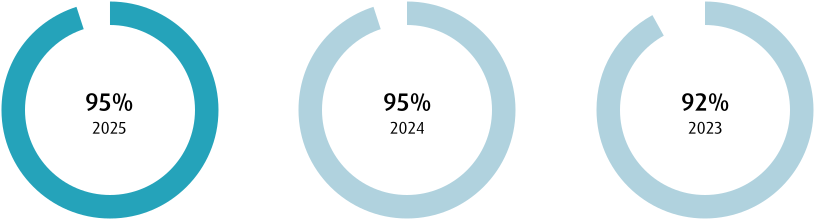
Regular and detailed risk analyses are conducted for all Linde MH workplaces, including both internal production and office facilities and the external working environments encountered by service technicians at customer premises. The aim of these analyses is to ensure that employees come to work healthy and return home healthy – without suffering any preventable damage to their health during or after the end of their careers. Part of this risk assessment also involves evaluating mental stress in the workplace. This is done by completing a systematic questionnaire to assess the risk to employees’ mental health due to stress, mental fatigue, monotony, mental saturation, and emotional exhaustion to determine specific countermeasures.
Percentage of Sites That Communicated a Risk Assessment
Handling Hazardous Substances and Agents
Special care must always be taken when handling hazardous substances. An interdisciplinary hazardous substances committee therefore monitors all listed working materials along with their safety data sheets, legal aspects, and application methods. This body also encourages their replacement with less harmful substances where necessary, defines protective measures, and is responsible for the approval of new substances.
All employees who work with a hazardous substance and all persons who may come into contact with hazardous substances are informed verbally about the hazardous substances and the correct, safe procedures for handling these substances at least once a year. This training covers the potential risks, safety precautions, and rules during use as well as actions to be taken in case of an emergency. Where appropriate, practical exercises also form part of the training. If a risk to health and safety cannot be eliminated by applying technical or organizational measures, personal protective equipment (PPE) must be used.
Emergency Management
How employees respond to an emergency situation (such as an accident, fire, or other unforeseen event) has a significant bearing on the incident outcome. For this reason, Linde MH has introduced a process that ensures an appropriate, rapid, and organized response.
Up-to-date emergency plans – with a bulleted list of the key action points – are therefore available at all sites and are displayed in a clearly visible location, such as close to the entrances or alongside fire extinguishers. Responsibility for creating these emergency plans lies with the site management, and they are supported in this task by their team of safety specialists and, where available, their fire officers.
Accidents and near-misses are recorded and carefully analyzed across all sites using a variety of different tools. At several Linde MH sites, for example, a special reporting app has been introduced to learn from unsafe or dangerous situations. Employees can use this app to report risk situations online so that appropriate preventive measures can be taken to prevent them arising again in the future. The reported situations and the countermeasures taken are available on the Intranet and can be viewed by all employees.
Systematic recording and analysis of such information can prevent negative consequences for the company and strengthen its reputation among customers, suppliers, investors, employees, and the public. In this way, Linde MH builds trust and can mitigate the negative impact of an incident that could affect any site and any employee.
Training
Regular training and instruction in occupational health and safety ensures employees and designated individuals (e.g., first responders, fire safety officers) are able to respond quickly and appropriately in hazardous situations. All conceivable company-specific incidents and scenarios must be covered.
New employees must complete workplace-specific training on the hazards relating to their activities and on protective measures and appropriate conduct in case of emergency before starting work and at least once a year thereafter. The precise nature of this training depends on the respective requirements. The respective manager is responsible for carrying out the training. Safety training includes (but is not limited to) the following topics:
Employee and manager responsibilities with respect to safety
Emergency protocols (raising the alarm, escape routes, assembly point, etc.)
Procedure for reporting accidents within the company
Contact information in case of emergencies
First aid and emergency equipment
Fire procedure and firefighting equipment
General company safety precautions
Alcohol and smoking policies
Availability and use of personal protective equipment (PPE)
Safe handling of hazardous substances
Safe use of machinery, cranes, and forklift trucks
Company’s environmental obligations
Potentially explosive areas
Performance of manual tasks
Wellbeing and hygiene
Safe use of hand-held tools and portable electrical devices
Safety awareness, incentives, and training to address specific areas of conduct
As part of the Group-wide training program for HSE specialists and managers, a comprehensive training package promoting a more proactive approach to HSE was offered for the first time. Additional training should also be conducted as and when needed – especially after accidents and near-misses. Any employees who miss a training session must catch up on the training at the earliest opportunity.
Field Service and Management of External Companies
Customer service employees ensure that Linde forklift trucks are always ready for use. Repair and maintenance work is often carried out directly on customers’ premises. To ensure optimal occupational health and safety for employees when working off-site too, the Service Compendium and the Linde Service Guide summarize key aspects and guidelines for safe off-site work and provide specific advice for practical implementation at the customer. Besides creating safe working conditions, they also address the ergonomic design of workplaces and service vans.
External contractors are required to inform their employees and any subcontractors about the regulations set out in the HSE information sheet of Linde MH before starting work at a plant. Whenever there is a change in personnel, supervisors must also inform new employees about the specific requirements applicable to the work or construction site before starting work, then regularly thereafter and in any case at least once a year.
Occupational Safety Key Performance Indicators
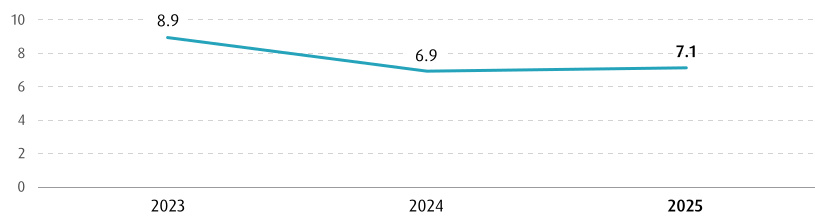
The key figure associated with the sustainability target of reducing the number of workplace accidents and lost time of more than one day due to accidents is the Lost Time Injury Frequency Rate (LTIFR1). Going forward, the aim is to reduce this limit and hence the accident frequency by at least 5 percent a year.
LTIFR (Lost Time Injury Frequency Rate1)
The KION Board OHS Award was created to recognize sites that demonstrate outstanding achievements in health and safety management. At the same time, the aim is to foster a culture of best practice and continuous improvement and to raise awareness of occupational health and safety (OHS) throughout the Group. By promoting the sharing of knowledge between the sites, the award also serves as a platform for the transfer of specialist knowledge and best practices, thus helping to create a safety-oriented culture in all organizational units. Winning this award not only strengthens stakeholder confidence, but also underlines a site’s commitment to robust OHS management systems.
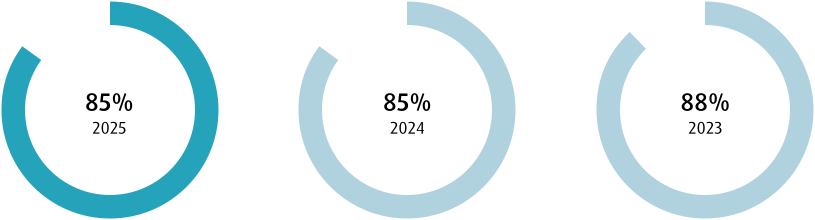
Percentage of Sites with an Official Joint Health and Safety Board
Audits and Certifications
HSE certifications ensure that all relevant HSE data is available in the required quality at all times so that corrective action can be taken quickly if necessary. Feedback from the certification and audit process also provides valuable strategic insights that help inform future actions and initiatives. To this end, all production sites and almost all sales organizations are now certified in accordance with ISO 45001 – the current occupational health and safety standard. Furthermore, the energy management system at the largest sites is certified according to ISO 50001. Feedback from the certification and audit process also provides valuable strategic insights that help inform future actions and initiatives.
Percentage of Sites Certified under ISO 45001

Regular HSE audits verify that the HSE management system is effective and that its elements are implemented at site level. Internal audits are carried out regularly – on at least a quarterly basis – by a qualified individual.