Performance, efficiency, reliability, user-friendliness, and versatility are what define the Linde MH portfolio. Sustainability and the careful use of resources have long been part of the brand promise, because true efficiency must take all operating costs into account. Linde MH therefore supports its customers with holistic solutions to save energy, reduce emissions, and optimize their environmental footprint.
Product Development
With uniform standards and global coordination of technical activities to shorten the development times despite a growing variety of product variants, the development approach of KION is geared towards efficiency. Product development projects initiated as needed by the product management team of the KION ITS EMEA Operating Unit are coordinated and overseen by the Group-wide CTO organization.
The innovative Product Evolution Process 2 (iPEP2) is the framework of KION for product development in the ITS segment. The basic idea is to tailor the process to a specific project. Every project has specific parameters and requirements that must be taken into account in project management. The implementation of these requirements is controlled by life cycle management software that organizes the requirements and documents the achievement of targets.
In 2025, selected iPEP2 product development processes were specifically updated to integrate sustainability aspects in a structured way. While existing deliverables were further developed in defined areas, the brand new “Product Sustainability Alignment” process represents a fundamental addition. The adjustments concern process requirements, evaluation steps, and data flows, so that environmental and circularity aspects are identified early, documented, and consistently managed via the life cycle management system.
In keeping with the overall strategy of KION, prioritizing the energy efficiency and sustainability of its products is also a key aspect for Linde MH. This includes reducing greenhouse gas (GHG) emissions during the product use phase and increasing the use of recyclable and recycled materials.
Linde MH relies on agile methods to achieve results and goals more quickly. A high degree of modularity helps optimize the use of materials and has a positive impact on logistics, production, and service. Intelligent platform concepts are an important element of this approach. In 2019, Linde MH introduced the first series of the new generation of counterbalance trucks with the Linde H20 – H35, in which all internal combustion engine and electric forklifts are based on a common platform. This allows significantly more identical parts to be used than in previous model series. This in turn reduces both the number of tools required for assembly and, in the medium term, the volume of spare parts that has to be carried in service vehicles across Europe. As a result, production and logistics costs fall, while efficiency in assembly and service rises.
The platform concept also made it possible to develop a new class of electric forklift trucks – the X models – which are in no way inferior to internal combustion engine forklifts in terms of performance and robustness and can replace them in any application. This makes it easier for customers of Linde MH to transition to more sustainable drive technologies and, as part of KION, helps the Group reach its target for 92 percent of products sold annually being electrically powered by 2027. In the reporting year, more than 91 percent of Linde MH vehicles sold were already equipped with an electric drive.
Introduced at the end of 2024 and launched during the reporting year, the Xi and E series in the one- to two-metric-ton capacity class represent the latest generation of electric counterbalance trucks. Since there is hardly any demand for diesel or gas-powered forklift trucks in this capacity class, no new H model is being introduced. Designed for particularly demanding applications, the Xi models feature an integrated lithium-ion battery, allowing for a larger and more ergonomic footwell. The E models likewise follow the plug-and-play principle and enable a cost-effective transition from lead-acid to lithium-ion or fuel-cell technology.
All forklift trucks in the new generation also feature a modern electrical and electronic system architecture and data transfer via cellular networks and Wi-Fi. This provides the basis for telematics applications, remote updates, remote diagnostics, and predictive maintenance, as well as for integrating the trucks into digital processes such as fleet and warehouse management – with the aim of extending the service life of the equipment and reducing resource consumption.
Together, the benefits of the platform concept and connectivity help reduce emissions during both the manufacturing and use phases and support customers in achieving their decarbonization targets.
Energy Management
New drive technologies are not the only way to reduce energy consumption – making better use of energy can also open up significant scope for savings. To further improve product efficiency, Linde MH is therefore developing solutions for networked control of chargers, for example. The aim is to avoid expensive peak demand and to efficiently control the power draw of individual chargers.
Linde MH uses data-driven consulting tools to help its customers find the ideal drive and energy system for their fleet and achieve their sustainability goals. In sales, employees use these tools during consultations to work with customers to capture all relevant criteria for choosing an energy system. Based on this information, software evaluates which energy solution – diesel, gas or biofuel, lead-acid battery or lithium-ion drive – best matches the customer’s operating conditions and goals from a cost and sustainability perspective, and quantifies the result as a percentage score. Expertise and test data from various customer projects were used in the development of the software and associated database.
In the reporting year, Linde MH introduced the Energy Calculator 2.0. This customer-oriented application simulates the use of various combinations of batteries and chargers based on customer-specific inputs. Key features include an energy consumption calculator, a CO2 comparison tool, and a comparison of the relevant costs of different energy system combinations – providing support for selecting the optimal energy system. The Energy Calculator 2.0 is a major advancement over its predecessor and explicitly considers not only costs but also environmental impact. Since its initial release in February 2025, the user base has grown steadily, and access has been gradually extended to sales staff and dealers. By supporting more informed and individually tailored customer consultations, the Energy Calculator 2.0 contributes to the adoption of energy-efficient solutions and helps strengthen the commitment of KION to climate-friendly technologies and responsible resource use.
Alternative Fuels and Drive Technologies
Linde MH also offers alternatives for industrial trucks with internal combustion engines: As early as 2022, KION received approval to use hydrotreated vegetable oil (HVO) as a fuel in Linde MH internal combustion forklift trucks. Depending on the manufacturer, a large proportion of HVO diesel is produced from renewable raw materials. Customers who use diesel forklift trucks can now fill up with this alternative diesel fuel, reducing GHG emissions by up to 90% compared with conventional diesel.
Energy-efficient lithium-ion batteries are available for the majority of the Linde MH fleet. They offer decisive advantages over conventional lead-acid batteries, including faster charging times and higher charging efficiency as well as a service life that is three to four times longer and a much higher energy content. In addition, the energy efficiency of lithium-ion batteries is over 90%, which enables users to achieve energy savings of around 30% as well as significantly reduce GHG emissions compared with a conventional battery-charger combination.
Hydrogen
At the customer’s request, Linde MH offers the factory integration of fuel cells into its industrial trucks as well as the “fuel cell ready” option. The aim of offering forklift trucks with fuel cell technology is to give customers an alternative source of energy. If hydrogen obtained from renewable energies is also used, the fleet then operates virtually emission-free and thus makes a significant contribution to GHG emission savings. Indeed, Linde MH already has one of the largest fuel-cell fleets in use at the production site of a well-known German automotive group.
Refurbishment and Recycling
For several years now, Linde MH has been offering attractive deals on rental and used trucks that reduce costs for the customer while at the same time conserving valuable primary resources. In the reporting year, Linde MH gave 32,168 used trucks a second life in the EMEA region – including all used vehicles sold to both end customers and dealers. Through this approach, Linde MH is making a solid contribution to the circular economy.
With its “Approved Trucks” concept, Linde MH has established a uniform, high standard. Only industrial trucks that have undergone a clearly defined process following the strictest guidelines are handed over to customers. Linde MH places great importance on trucks having an impeccable history: The used trucks come either from the company’s own rental fleet or are leasing returns.
Another building block of the circular economy is the responsible handling of lithium-ion batteries. As well as producing its own lithium-ion batteries, KION also places particular emphasis on refurbishment and recycling. A key question for the future is what happens to these batteries once they have reached the guaranteed number of charging cycles. This is where the return guarantee of Linde MH comes in: The nearest network partner in the country concerned takes back the batteries, thus ensuring that Linde MH fulfills its legal obligation. Linde MH lithium-ion batteries go through a life cycle process with the aim of taking full advantage of the extraordinary lifespan of this technology:
Step 1: Refurbishment
Thanks to the long lifespan of lithium-ion batteries, batteries that have reached a certain state of health (SoH) can be cleaned, refurbished, and reused in a new or used truck. Depending on battery usage, this cycle can usually be repeated several times.
Step 2: Remanufacturing
If the used battery no longer meets the requirements for reuse in a forklift truck but is still functional, parts are repurposed for other operations (such as cell modules in stationary operations or reconditioned steel trays for new batteries).
Step 3: Recycling
Once a battery reaches the end of its life, it is disassembled into its composite parts and recycled by material type. Cells and modules are recycled in a two-stage process, allowing the recovery of the resources they contain. Since 2023 KION has maintained a strategic partnership with Li-Cycle Holdings Corporation. Li-Cycle was acquired by Glencore Battery Recycling GmbH (GBR) in 2025; however, the partnership continues unchanged and allows the Group to send returned lithium-ion modules to GBR for processing. In 2025, nearly 10 metric tons of battery modules, equivalent to 343 batteries, were returned to Linde MH and went through the established recycling process at GBR.
The advances made were supported by a web-based application implemented in 2025, which standardizes and digitizes the returns process across Europe. This shortens lead times, increases efficiency, and promotes the circular economy while simultaneously reducing the need for primary raw materials and lowering environmental impacts.
Linde MH also uses a well-established recycling loop for lead-acid batteries in which the manufacturers handle the recycling process.
The disposal of old forklift trucks is regulated by Directive 2000/53/EC of the European Parliament and Council. Linde MH therefore provides detailed information on the disposal of forklift trucks at approved recycling plants.
Life Cycle Assessments
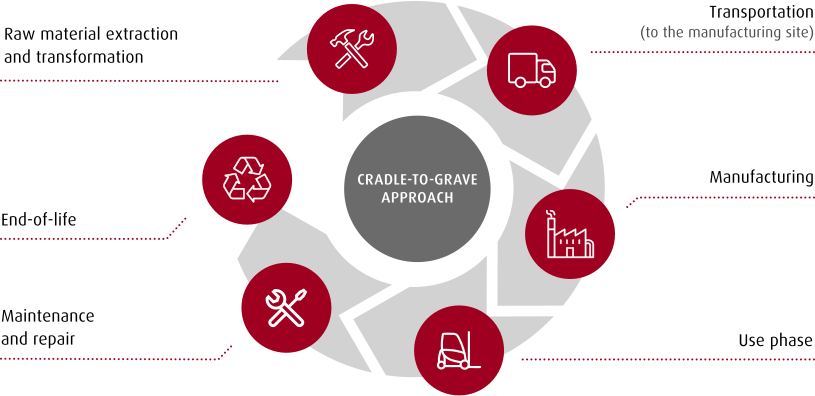
The life cycle assessments (LCAs) prepared for Linde MH products show that the use phase is the main source of GHG emissions if customers use a traditional energy mix. The energy efficiency of the power units is therefore a key focus – both for internal combustion engines and in the further development of powerful and efficient electric drive technologies.
To ensure consistent and reliable environmental data, KION has invested in robust life cycle assessment methods that serve as a basis for decisions throughout the entire product life cycle. The LCA team provides these analyses to steer internal environmental management strategies and to identify opportunities for further emission reductions.
Linde MH, as part of KION, has offered LCA training since 2024 to all employees – from managers to technicians. Building on this, in 2025 KION made relevant training courses available to all employees on its e-learning platform, covering both theoretical foundations and practical applications. These courses enable product developers and all interested employees to make more informed decisions regarding materials, design, and component lifespan. This has been complemented by a structured, multi-stage program that gives all interested employees a basic understanding of ISO 14040/14044 and offers specialists advanced technical modules to firmly embed life-cycle thinking in day-to-day product decisions.
In the 2025 reporting year, LCAs were also newly prepared for four Linde forklift truck series – a key step toward systematically recording and managing the product portfolio’s environmental footprint. Another milestone was the product-related carbon footprint of the Linde N20 order picker (SV type 1115 N20), which was first independently verified in accordance with ISO 14067 in December 2024 and updated in June 2025.
Cradle-To-Grave Approach